
Tree Removal Cost: Factors & Price Ranges
Home Services, Tree Removal Pricing
How Much Does Tree Removal Cost? Typical Price Ranges and What Really Affects Your Quote
Understanding tree removal pricing helps you budget confidently, compare quotes fairly, and avoid unpleasant surprises once the work begins.
Typical Tree Removal Price Ranges
While exact costs in 2026 will depend on your local market and inflation, recent national data gives a reliable starting point. Most homeowners pay somewhere between $200 and $2,000 to remove a single tree, with an average around $700–$750 according to HomeAdvisor, Angi, and other cost guides (HomeAdvisor, Angi, HomeGuide).
To make those numbers more practical, here is a rough breakdown by tree size, based on recent guides from HomeAdvisor, Thumbtack, and Trees.com:
Tree Size (Height) Typical Price Range* Common Examples Small (up to ~30 ft) ~$150 – $400 Ornamental trees, young maples, small fruit trees Medium (~30–60 ft) ~$300 – $800 Larger fruit trees, many backyard shade trees Large (~60–80 ft) ~$700 – $1,500+ Mature oaks, elms, big pines near homes Very Large (80+ ft) $1,000 – $2,000+ Towering pines, heritage trees, complex removals
*These are broad national estimates. Your local prices may be higher or lower depending on labor rates, demand, and regulations in your area.
Key Factors That Affect Tree Removal Price
Two homeowners can pay very different amounts to remove trees that look similar at first glance. That is because arborists price jobs on risk, difficulty, and time, not just height. Here are the main factors that can move your quote up or down.
1. Tree Size, Height, and Diameter
Taller, thicker trees require more labor, more cutting, and often heavier equipment. A small ornamental tree may be cut and hauled in under an hour, while a massive oak can take a full crew most of the day, which explains the jump from a few hundred dollars to well over $1,500 on large jobs.
2. Tree Species and Wood Density
Some species have very dense, heavy wood or wide, awkward crowns. Hardwoods like oak and hickory can be more demanding to cut and move than softer species. Certain trees also tend to grow in shapes that complicate rigging and safe drop zones, which can add to cost.
3. Location and Accessibility
A tree standing in an open front yard is usually cheaper to remove than one squeezed between houses, over a fence, or near power lines. Limited access for trucks and chippers, tight backyards, or obstacles like sheds and pools all increase the time and care required, often pushing the price toward the higher end of the range.
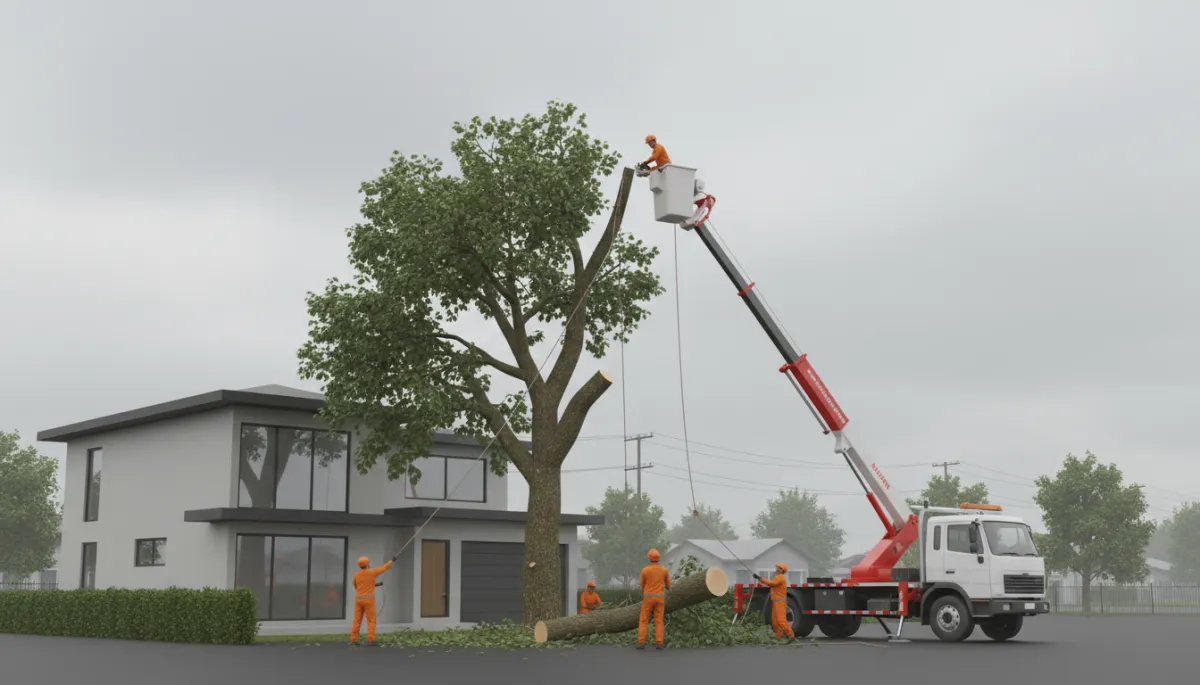
Tight spaces, nearby homes, and power lines can significantly increase removal costs.
4. Tree Condition and Safety Risks
Dead, diseased, or storm-damaged trees can be unpredictable. Brittle limbs, hollow trunks, or severe lean may require specialized rigging, cranes, or extra crew members to prevent sudden failures. That added risk and complexity often translates into a higher quote than for a healthy, stable tree of the same size.
5. Cleanup, Hauling, and Stump Services
Be clear on what your estimate includes. A basic quote might cover felling the tree and leaving the wood on-site. Full-service removal usually costs more and can include:
Limbs chipped and removed from the property
Logs cut to firewood length or hauled away
Stump grinding or complete root removal for an additional fee
Stump grinding alone can add anywhere from about $75 to several hundred dollars, depending on stump size, depth, and access.
6. Timing, Permits, and Local Market Conditions
Seasonal demand plays a role. After major storms or during peak growing seasons, crews may be booked out, and emergency work (such as a tree on a roof) often commands premium pricing. In some cities, you may also need permits or inspections to remove certain trees, which adds to the overall cost. Finally, local labor rates and competition between companies will influence what you pay in your area.
Getting a Fair, Accurate Tree Removal Quote
Because so many variables affect price, the most reliable way to budget is to gather at least two or three written estimates from licensed, insured tree services in your area. Ask each company what is included, how they will access the tree, and whether stump grinding, permits, or emergency surcharges apply. With a clear understanding of typical price ranges and the factors that drive them, you will be better prepared to choose a provider who offers both safety and value.